
At I’mWATER TREATMENT PLANTS, S.L., we have spent years working with a clear goal: to offer efficient and sustainable solutions that ensure access to quality water, even in the most demanding contexts. One of the sectors where this need is most urgent is agriculture, which accounts for nearly 70% of global freshwater consumption and 80% in Spain.
In a global scenario marked by climate change, overexploitation of aquifers, and increasing food demand, access to irrigation water can no longer rely solely on traditional sources strictly dependent on weather patterns.
Desalination and reuse are increasingly emerging as viable alternatives for obtaining a water supply that is independent, economically competitive, predictable, and of high quality. At I’mWATER, we explain how this is possible.
ACCESS TO ALTERNATIVE WATER SOURCES
Alternative water sources are considered those whose quality is not sufficient for direct use without the application of advanced treatment technologies. The most relevant alternative sources are:
-
Seawater
-
Brackish groundwater
-
Treated wastewater effluents
These non-conventional sources are generally abundant in most regions of the world, but their quality is inadequate for irrigation—mainly due to high salinity levels and, in some cases, suspended solids (including microorganisms).
In this context, reverse osmosis and ultrafiltration are ideal technologies to tap into water sources that are often overlooked.
REVERSE OSMOSIS: MEMBRANE TECHNOLOGY FOR SALT REDUCTION
Reverse osmosis is the leading desalination technology worldwide, allowing for the reduction of salt concentrations in water. This is achieved by pressurizing the water to force it through a semi-permeable membrane. Water molecules pass through, while most salts are retained, resulting in separation.
Reverse osmosis makes it possible to reduce salt content in seawater, brackish groundwater, and even treated wastewater effluents to optimal levels for irrigation. The pace of reverse osmosis plant installations is rapidly increasing globally, and Spain is no exception, producing 5,000,000 m³/day of desalinated water daily for municipal supply, industrial use, and of course, irrigation.
ULTRAFILTRATION: MEMBRANE TECHNOLOGY FOR SUSPENDED SOLID REMOVAL
Ultrafiltration is one of the most efficient filtration technologies available today for removing suspended solids from water. Water is forced under pressure through membranes with very small pore sizes, allowing water and dissolved salts to pass while retaining most suspended solids, including viruses and bacteria. Unlike reverse osmosis, the pore size is not small enough to retain dissolved salts.
Ultrafiltration is a key ally in water reuse and is increasingly used as a polishing treatment in wastewater treatment plants. This makes it possible to extend the use of already-used water, generating additional water resources for industrial and agricultural uses.
I’MWATER: WATER TREATMENT PLANT MANUFACTURER FOR AGRICULTURAL USE
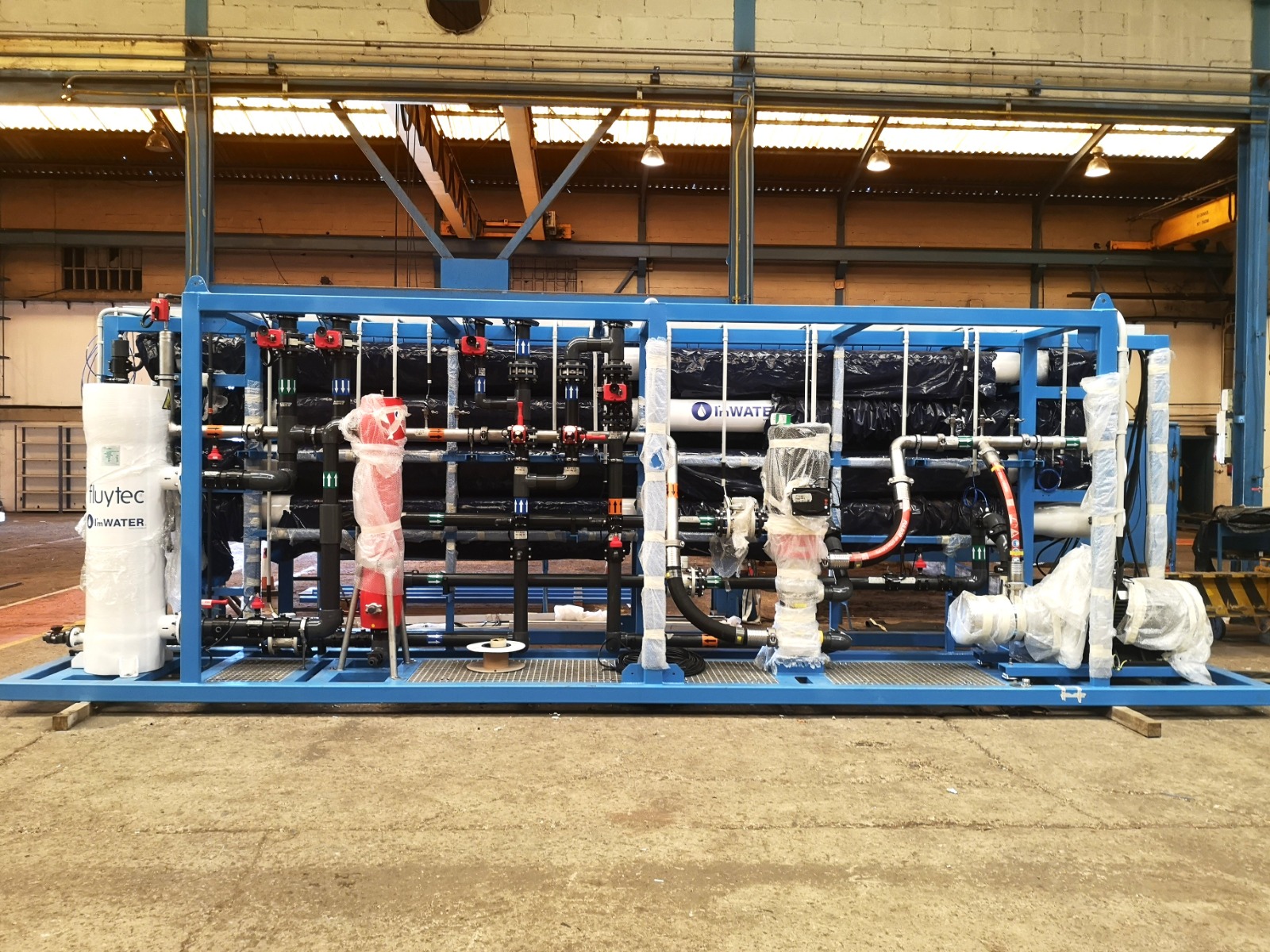
At I’mWATER, we specialize in the custom design and manufacturing of water treatment plants using ultrafiltration and reverse osmosis technologies to produce irrigation water. Our plants are modular, compact, easy to operate, and energy-efficient, with flow rates starting at 100 m³/day or less, and going beyond 5,000 m³/day. They can be installed on skids or inside shipping containers.
These plants enable cooperatives, agricultural operations, and irrigation communities to secure a reliable, consistent, high-quality, and competitively priced water source, ensuring the continuity and success of their business.
Do you work in the agricultural sector and need to optimize your water use?
Contact us with no obligation. We’ll be happy to assess your case and help implement a solution tailored to your needs: