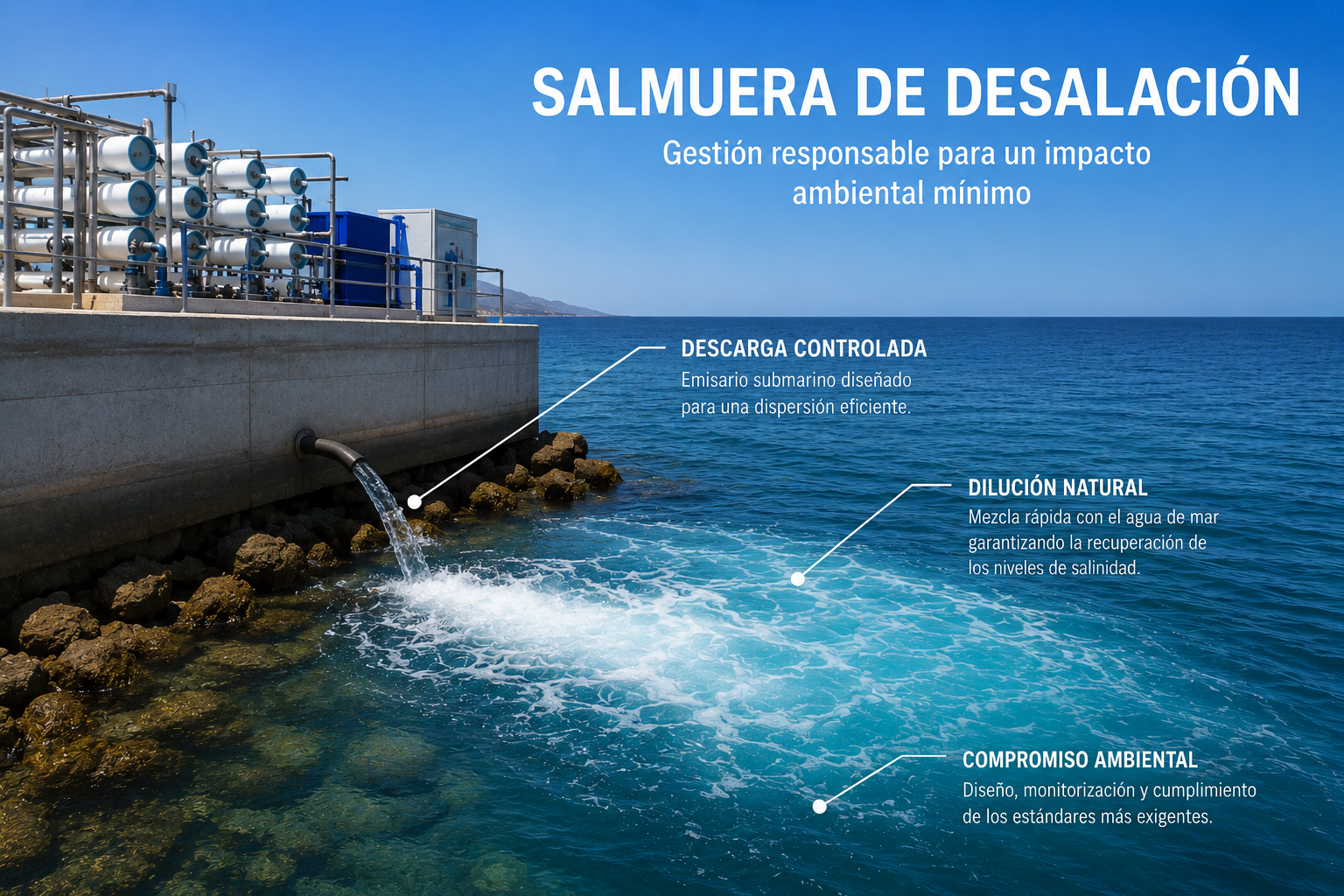
What happens to the brine from a desalination plant?
Valuing Brine in Desalination Plant Management
One of the aspects that generates the most interest surrounding desalination plants is the final destination of the brine produced during the reverse osmosis process.
It is a logical and increasingly frequent question among public administrations, industries, tourist resorts, yacht clubs, and water project developers:
Is the brine discharged into the sea? Is it polluting? Can it be utilized to generate waste that can be optimized with sustainable alternatives?
The short answer is: yes, brine can be managed safely, in a controlled manner, and can even become a useful resource in certain desalination projects.
In this article, we explain exactly what brine is, how it is currently managed in modern desalination plants, and what opportunities currently exist to transform this byproduct into a source of added value.
What is brine?
In a reverse osmosis desalination plant, seawater or brackish water passes through membranes capable of separating dissolved salts and minerals. The process generates two main streams:
-
Permeate or product water $\rightarrow$ high-quality water suitable for consumption, industrial processes, or irrigation.
-
Concentrate or brine $\rightarrow$ a stream with a higher salt concentration than the feed water.
For example:
-
Seawater typically contains approximately 35 g/L of salts.
-
The generated brine can reach concentrations of 60–75 g/L, depending on the design and recovery rate of the plant.
It is important to understand that brine is not a toxic chemical waste, but rather water with a higher concentration of natural mineral salts.
Is the brine discharged into the sea?
Yes, in many coastal facilities the brine is returned to the sea, but always under strict technical and environmental criteria. Modern desalination plant projects incorporate:
-
Environmental impact studies.
-
Underwater diffusion systems.
-
Hydraulic dispersion models.
-
Temperature and salinity control.
-
Continuous environmental monitoring.
The goal is to guarantee rapid dilution and prevent negative impacts on the marine ecosystem. In Spain, current legislation allows brine discharge into the sea for projects with a capacity of up to 3,000 m³/day.
Why does brine usually not cause significant impacts?
When a desalination plant is properly designed, the brine:
-
is discharged via outfalls and diffusers,
-
mixes rapidly with seawater,
-
and recovers natural salinity levels a short distance from the discharge point.
Additionally, many facilities take advantage of:
-
natural marine currents,
-
areas with high water turnover,
-
and blending systems with other compatible effluents.
The key lies in the engineering of the discharge system. At ImWater, hydraulic design and environmental respect and management form an integral part of our solutions’ development, especially in coastal, tourism, and industrial projects.
Can brine be utilized?
This is where desalination is evolving rapidly. Brine is no longer considered solely a byproduct, but a potential source of resources and raw materials. Some emerging applications include:
1. Recovery of salts and minerals
Brine contains elements of industrial interest such as:
-
sodium, magnesium, calcium, potassium, lithium (in certain cases), bromine, and other minerals.
Projects currently exist focused on recovering these compounds for:
-
the chemical industry, fertilizers, batteries, cosmetics, food, and the pharmaceutical industry.
2. Industrial salt production
In certain locations, especially those with high solar radiation, brine can be used for:
-
industrial salt pans, sea salt production, and the generation of sodium hypochlorite or caustic soda.
The most common elements present are typically sodium and chloride, along with sulfates, magnesium, calcium, and potassium. However, minerals and metals found in low concentrations in the sea can also be extracted. This is known as “desalination mining.”
3. Aquaculture and biotechnology
Some marine species and microorganisms thrive in hypersaline environments. There is ongoing research and real-world applications for:
-
microalgae cultivation, specialized aquaculture, biomass production, and bioactive compounds.
4. Zero Liquid Discharge (ZLD) Systems
In specific industrial applications, advanced technologies are used to minimize or completely eliminate liquid discharge. These systems combine:
-
evaporation, crystallization, water recovery, and salt valorization.
Although their energy cost is high, they represent an interesting solution for industries where discharge is restricted or water holds high strategic value.
In fact, using brine for energy generation represents one of today’s great challenges. Due to the high saline concentration of brine, and by utilizing another low-salinity source, energies capable of generating power can be developed.
Utilizing the brine generated in desalination processes for the aquaculture industry makes it possible to obtain a high-value final product for sectors like the food industry, as well as to develop marine algae with high nutritional value.
Sustainability in Modern Desalination
The desalination industry has evolved enormously in recent years. Today, modern plants stand out for:
-
lower energy consumption,
-
energy recovery systems,
-
integration with solar photovoltaic energy,
-
advanced automation,
-
reduction of chemical products,
-
hydraulic optimization,
-
and continuous improvement in environmental management.
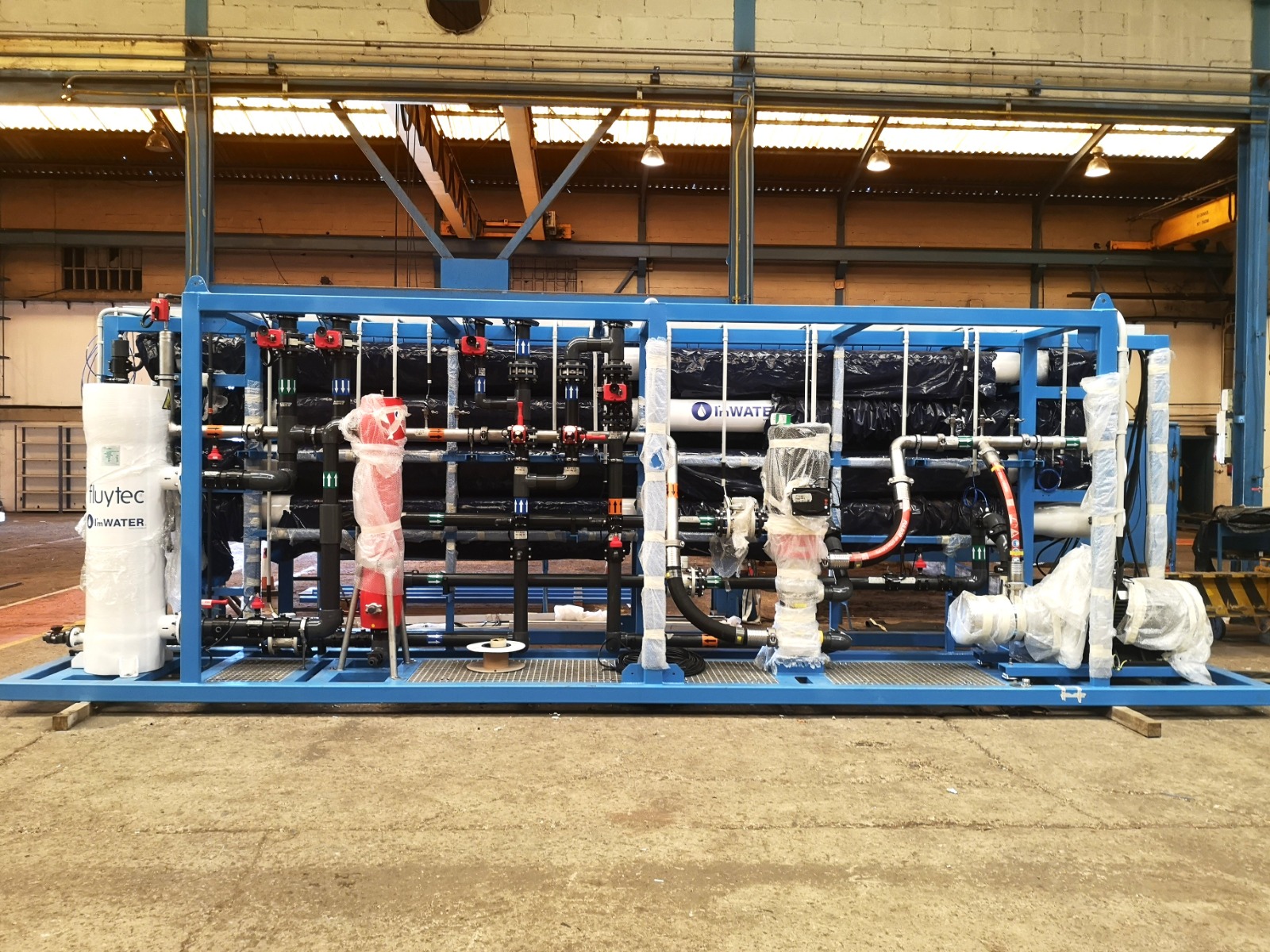
At ImWater, we are committed to compact, modular, and containerized solutions that allow each project to be adapted to the client’s real needs, minimizing operating costs and simplifying installation and maintenance. Furthermore, our plants can be integrated with photovoltaic systems to significantly reduce energy consumption and improve the overall sustainability of the facility.
Conclusion
Brine should not be understood as an unavoidable “problem” of desalination, but rather as a stream that requires proper technical management and increasingly offers opportunities for valorization.
The technological evolution of the sector is allowing us to:
-
reduce impacts,
-
improve efficiency,
-
recover resources, valorize brine as a valuable asset for other industrial and food applications, etc.,
-
and develop more sustainable, environmentally friendly models.
More information at: ImWater